


Mental Training in Handball – The Champion’s Mindset
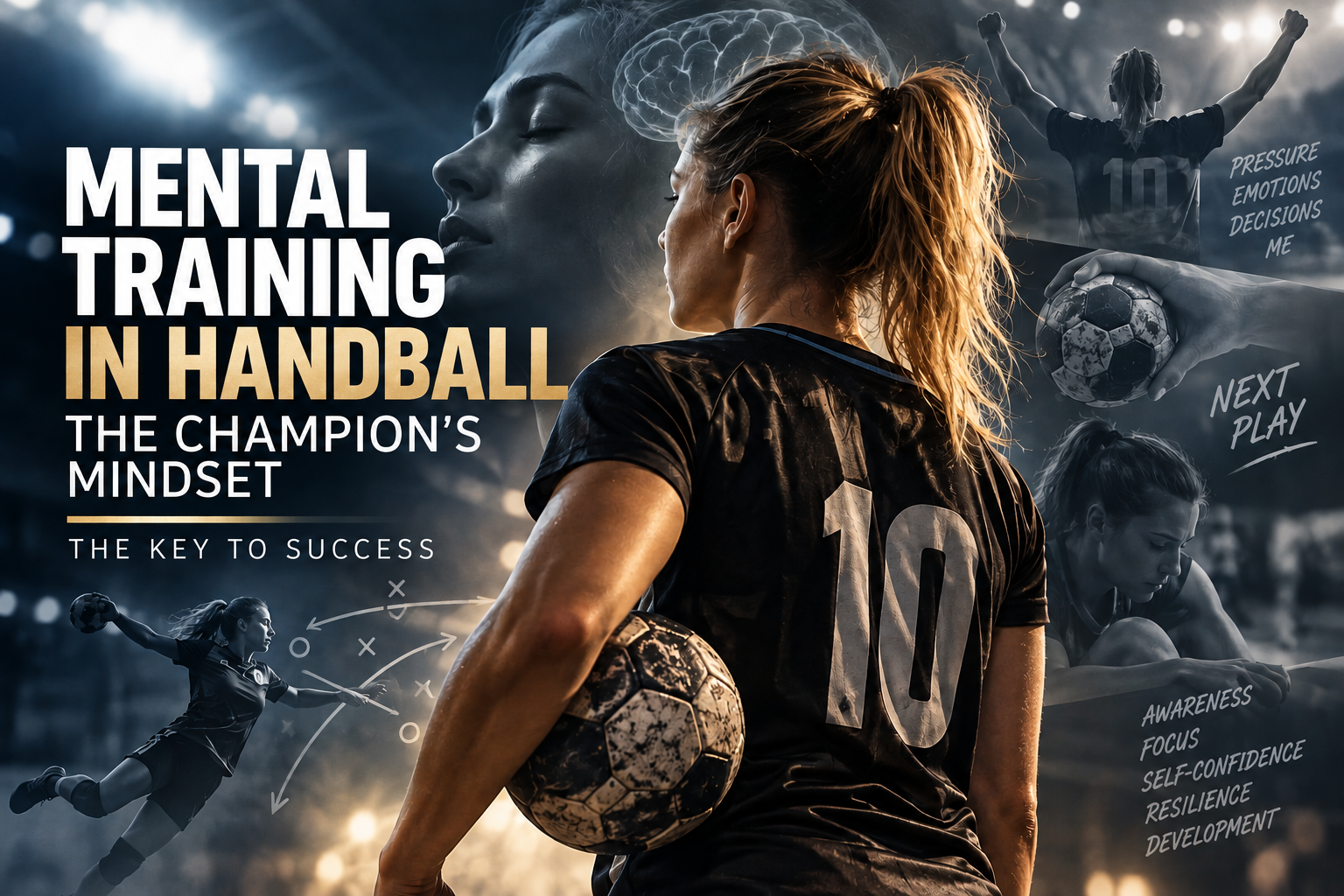

Mental Training in Handball - The Champion’s Mindset
In sport, you can be extremely well prepared physically. You can have the technique, talent and experience, and understand tactical principles perfectly. But there comes a moment in a game when something else begins to determine your performance.
What is happening in your mind.
The final moments of the game. A tie score. A penalty throw. A mistake you made just seconds earlier. The pressure of the result. The noise from the stands. A referee’s decision you disagree with. Fatigue. An opponent who has just scored three goals in a row.
And that is exactly when your mindset reveals itself.
For me, mental training is not an addition to athletic preparation. It is one of its foundations.
Over the years, I have experienced sport from both perspectives – as an athlete and as a coach. I know what victory feels like, but I also know pressure, defeat, self-doubt, expectations and those moments when you have to step up and fight again.
That is why my work with athletes is based on the philosophy of the Champion’s Mindset.
Because championship does not begin on the podium.
It begins within you.
What is the Champion’s Mindset?
The Champion’s Mindset is a way of thinking, responding and acting that allows an athlete to access their potential even when pressure, stress, fatigue, mistakes or uncertainty appear.
It is not about always feeling confident.
It is not about never being afraid.
It is not even about always thinking positively.
It is about knowing yourself well enough to consciously manage yourself in the moments that matter most.
An athlete can feel stressed and still play an outstanding game. They can make a mistake without allowing that mistake to affect the next five plays. They can feel pressure and still make a courageous decision.
That is what mental training means to me.
1. Awareness - know yourself as an athlete
The first step is not change.
The first step is awareness.
What happens to me under pressure?
How do I react after making a mistake?
What do I think when the coach puts me on the bench?
What happens in my mind when the opponent starts taking control of the game?
How do I react when my first few plays do not go as planned?
After losing the ball, am I still present in the game, or am I mentally stuck in the previous situation?
The better an athlete understands their own reactions, the more influence they have over them.
You cannot consciously manage something you do not notice within yourself.
2. Focus - the next play
In handball, everything can change within seconds.
That is why one of the most important mental skills is the ability to return to the HERE AND NOW.
The mistake has already happened.
The missed shot has already happened.
So has the referee’s decision.
The question is:
Where are you now?
A champion is not an athlete who never makes mistakes. A champion is an athlete who knows how to quickly return to their game.
That is why one of the most powerful phrases in sport can be:
NEXT PLAY.
You cannot change the previous one.
You have influence over the next one.
3. Pressure - learn how to perform with it
Pressure is part of sport.
The higher the stakes, the more often it appears.
I do not teach athletes that they should stop feeling pressure. I teach them to understand their own reactions and use tools that help them return to their optimal state.
These tools can include conscious breathing, focusing on the task, pre-game routines, visualization and intentionally chosen self-talk.
The goal is not to create an athlete who is unaffected by anything.
The goal is to develop an athlete who can still perform effectively when emotions run high.
4. Self-confidence - build it on more than the result
If your confidence depends entirely on your last game, the number of goals you scored or your coach’s opinion, it will always be unstable.
Good game - I am great.
Bad game - I start doubting myself.
The Champion’s Mindset builds confidence on a deeper foundation.
On awareness of your own strengths.
On preparation.
On experience.
On the work you have put in.
On your ability to get back up.
On trust in yourself.
An athlete needs to learn to separate:
“I made a mistake” from “I am a bad player.”
These are two completely different things.
A mistake is information. It can become material for growth.
It does not have to define the athlete.
5. Mental resilience - it is not about never falling
Sport will test you many times.
A lost game. An injury. Not being selected. Sitting on the bench. Criticism. A difficult period. Competing for a place in the team. A mistake at the most important moment.
Mental resilience does not mean that nothing affects you.
It means that you can move through a difficult moment, learn from it and redirect your energy towards what you can influence.
Instead of asking:
“Why did this happen to me?”
learn to ask:
“What can I do with this?”
That is a powerful shift in perspective.
You move from a position of helplessness to a position of influence and agency.
6. Visualization - see it in your mind first
Imagine the final seconds of the game.
You receive the ball.
You hear the crowd.
You feel the tension.
You see the goalkeeper.
And you execute exactly the movement you have practised hundreds of times.
Visualization can prepare an athlete not only for ideal scenarios, but also for difficult situations.
What will I do if I miss my first shot?
How will I react after losing the ball?
How will I respond under pressure?
How do I want to enter the game from the bench?
How will I take a penalty throw in the final moments of the game?
In this way, an athlete can prepare their response before the situation happens in real life.
7. Self-talk - the way you speak to yourself matters
Throughout the entire game, an athlete is having a conversation with themselves.
“I can’t mess this up again.”
“I have to score.”
“I’m playing terribly.”
Or:
“Next play.”
“Breathe.”
“I know what to do.”
“I’m getting back into my game.”
These are not magic phrases.
They are a way of consciously directing your attention.
That is why, rather than using random affirmations, I work with messages that are short, authentic to the athlete and lead them towards a specific action.
8. Focus on what you can influence
One of the foundations of the Champion’s Mindset is the ability to distinguish between what you can influence and what you cannot.
You do not have complete control over the referee’s decisions.
You cannot control the crowd’s reaction.
You cannot control your opponent.
You cannot always control the final result.
But you do have influence over your preparation, commitment, concentration, communication, your reaction after a mistake and the decision you make in the next play.
The more energy an athlete directs towards what they can actually influence, the more agency they regain.
How do you train your mind the same way you train your body?
Mental training works when it becomes a process, rather than a one-off conversation before an important game.
Some of the tools you can use include:
- short breathing routines before training sessions and games,
- visualization of specific game situations,
- personal focus cues,
- an athlete’s journal,
- analysing your reactions after mistakes,
- working on your self-talk,
- concentration training,
- consciously developing a pre-game routine,
- simulating pressure during training,
- regularly asking yourself: “What can I influence right now?”
Just as muscles need repetition, mental skills require consistent training.
Championship begins long before the podium
The greatest value of mental training is not creating an athlete who is never afraid, never makes mistakes and is always confident.
That athlete does not exist.
The goal is to develop a self-aware athlete.
An athlete who knows what happens within them under pressure.
Who knows how to come back after a mistake.
Who understands their emotions.
Who knows their strengths and resources.
Who knows what they can influence.
And who, even in a difficult moment, can make a decision:
I’m back. I’m here. Next play.
Because true championship does not begin with a medal, a result or a position in the standings.
It begins much earlier.
In the way you think.
In the way you respond.
In the decisions you make when things get difficult.
That is what I call the Champion’s Mindset.
Where the heart and mind meet, championship is born.
Join our community!
Create a profile and start your handball adventure today!
