
Handball Training Compensation – How Is It Calculated? Current ZPRP Regulations for the 2026/2027 Season


Handball Training Compensation - How Is It Calculated? Current ZPRP Regulations for the 2026/2027 Season
This article was co-authored and reviewed for factual accuracy by Mr. Jakub Skorupa, the Commissioner for Club Transfers at the Polish Handball Federation (ZPRP).
I would like to express my sincere gratitude to Mr. Skorupa for his involvement, for sharing his specialist knowledge, and for providing valuable guidance that helped make this article a reliable and practical resource for the entire handball community.
Changing clubs in handball does not always simply mean signing a new contract and starting training with a new team. In some cases, it also involves an obligation to pay training compensation for the player.
How much is this compensation? Who is responsible for paying it? What determines the amount?
In this article, we explain the regulations applicable from the 2026/2027 season, based on the rules established by the Polish Handball Federation (ZPRP).
What Is Training Compensation in Handball?
Training compensation is an amount that the acquiring club is required to pay to the releasing club in recognition of the player's previous training and athletic development.
Its purpose is to acknowledge the coaching and development work carried out by the club that has invested in the player over the years.
The amount of compensation may be agreed upon directly between the clubs. However, if the parties cannot reach an agreement, the acquiring club may apply to the Commissioner for Club Transfers (KZBK) to determine the amount in accordance with the applicable regulations.
Important: The rules described for determining compensation in the event of a dispute do not apply to players who have a valid contract with their releasing club.
When Is Training Compensation Applicable?
According to ZPRP regulations, training compensation applies to male and female players changing clubs from the calendar year in which they turn 15 until the calendar year in which they turn 23, inclusive.
However, when calculating the amount of compensation, the training period is taken into account starting from the calendar year in which the player turned 12.
This means that if a player changes clubs at the age of 18, their earlier years of training may also be included in the calculation, beginning with the year in which they turned 12.
How Is Training Compensation Calculated?
The ZPRP establishes the following formula:
Training Compensation = Number of Training Years × Base Rate × Adjustment Coefficient
In practice, because the base rate changes depending on the player's age, the training value must be calculated separately for each age category before applying the relevant coefficient.
Three main factors determine the compensation amount:
- Training period - the number of calendar years during which the player was registered with the club and received training.
- Base rate - determined by the player's gender and age.
- Adjustment coefficient - determined by the competition level of the acquiring club.
If training covered only part of a calendar year, 1/12 of the annual rate is calculated for each commenced month of training.
Base Training Compensation Rates for Female and Male Players
The following rates apply from the 2026/2027 season:
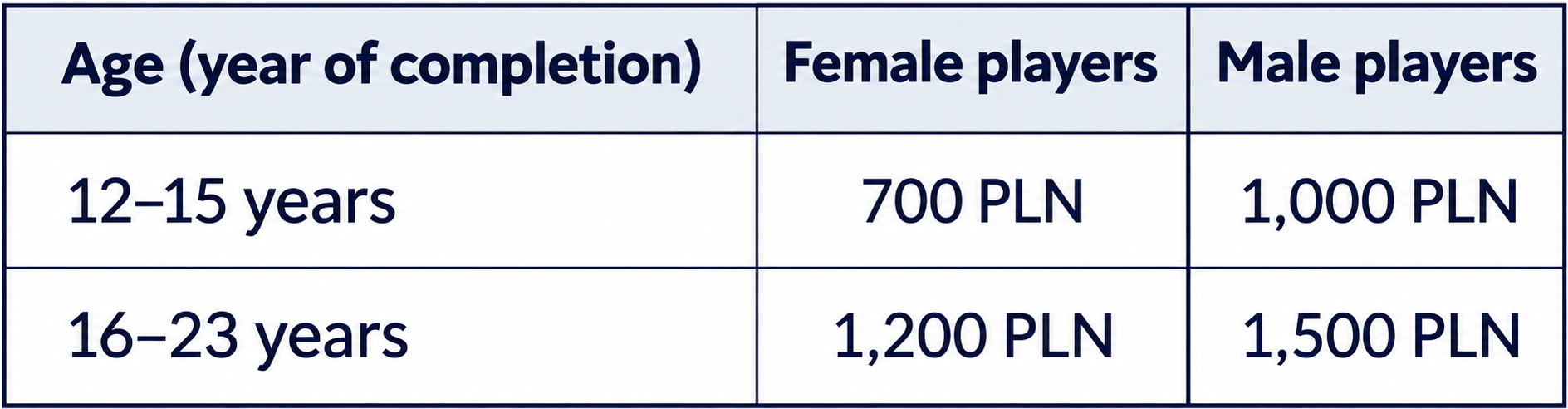
These are the rates for each year of training before applying the adjustment coefficient.
Adjustment Coefficient - Why the Competition Level Matters
Another important factor is the competition level of the club the player is joining.
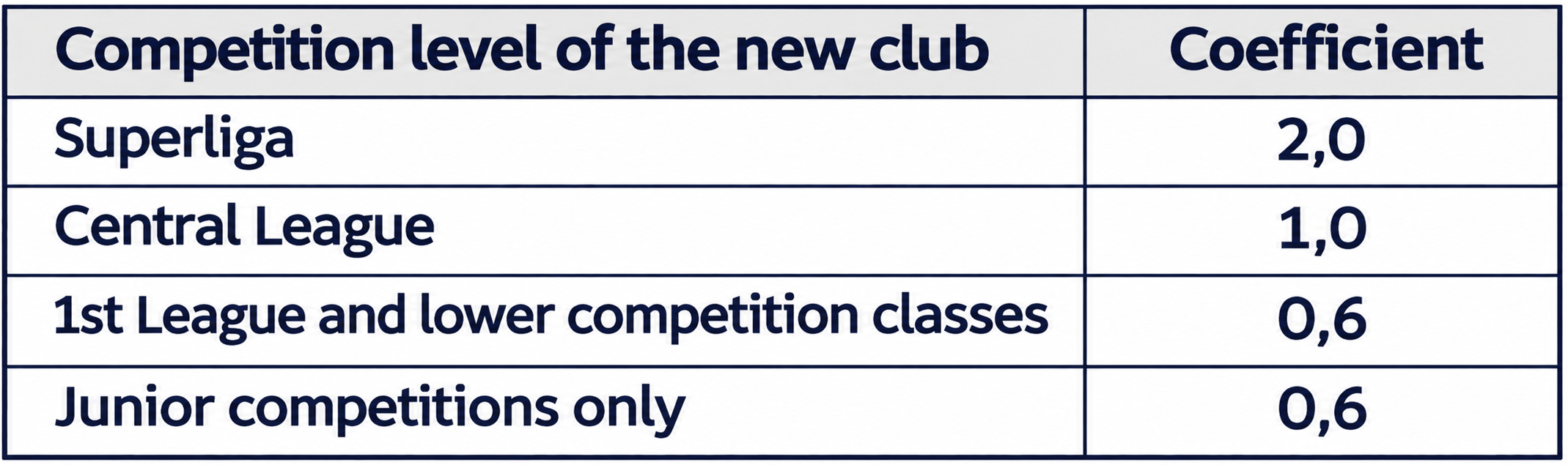
The higher the competition level of the acquiring club, the higher the potential training compensation.
Example 1. An 18-Year-Old Female Player Transfers to a First League Club
Let's assume that a female player trained with her previous club for six full calendar years, from the year in which she turned 12 until the year in which she turned 17.
In the calendar year in which she turns 18, she transfers to a First League club.
Calculation:
- 4 years of training (ages 12–15): 4 × PLN 700 = PLN 2,800
- 2 years of training (ages 16–17): 2 × PLN 1,200 = PLN 2,400
- Total training value: PLN 5,200
- First League coefficient: 0.6
Training Compensation: PLN 5,200 × 0.6 = PLN 3,120
In this example, the training compensation for the female player amounts to PLN 3,120 net.
Example 2. A 20-Year-Old Male Player Transfers to the Central League
A male player has been trained for eight full calendar years, from the year in which he turned 12 until the year in which he turned 19.
He now changes clubs and joins a Central League team.
Calculation:
- 4 years of training (ages 12–15): 4 × PLN 1,000 = PLN 4,000
- 4 years of training (ages 16–19): 4 × PLN 1,500 = PLN 6,000
- Total training value: PLN 10,000
- Central League coefficient: 1.0
Training Compensation: PLN 10,000 × 1.0 = PLN 10,000
The acquiring club must therefore take into account training compensation of PLN 10,000 net.
Example 3. A 21-Year-Old Female Player Transfers to the Superliga
A female player has trained with her previous club for nine full calendar years, from the year in which she turned 12 until the year in which she turned 20.
She receives an offer to join a Superliga club.
Calculation:
- 4 years of training (ages 12–15): 4 × PLN 700 = PLN 2,800
- 5 years of training (ages 16–20): 5 × PLN 1,200 = PLN 6,000
- Total training value: PLN 8,800
- Superliga coefficient: 2.0
Training Compensation: PLN 8,800 × 2.0 = PLN 17,600
In this case, the training compensation amounts to PLN 17,600 net.
As these examples demonstrate, the competition level of the acquiring club can significantly affect the final compensation amount.
What Happens If the Training Period Covers Only Part of a Year?
A player does not always begin training on January 1 or remain with a club until the end of the calendar year.
The ZPRP regulations specify that 1/12 of the relevant annual rate is calculated for each commenced month of training.
Example:
A male player received training for five commenced months during the calendar year in which he turned 17.
The annual base rate is PLN 1,500.
5/12 × PLN 1,500 = PLN 625.
If the player transfers to a First League club, applying the coefficient of 0.6 gives:
PLN 625 × 0.6 = PLN 375 net.
This represents the training compensation attributable to that specific training period. Any other eligible training periods must be added to determine the total amount.
Can Training Compensation Increase After a Transfer?
Yes. This is particularly important for clubs acquiring young players.
If, within one year of the transfer date, the player participates in at least one match at a higher competition level than the one for which they were originally acquired, the releasing club has the right to request an increase in training compensation based on the higher coefficient.
Example:
A male player transfers to a First League club. His total training value before applying the coefficient is PLN 8,000.
Initial training compensation:
PLN 8,000 × 0.6 = PLN 4,800.
A few months later, the player participates in a Central League match.
Training compensation based on the new coefficient:
PLN 8,000 × 1.0 = PLN 8,000.
The releasing club may then request payment of the difference, amounting to PLN 3,200.
Does a Player Loan Reduce Training Compensation?
No. According to ZPRP regulations, a temporary transfer during the training period does not reduce the training compensation amount.
Furthermore, the club to which the player was temporarily loaned does not acquire the right to receive training compensation on that basis.
Therefore, the loan period should not automatically be deducted from the training period considered in the calculation.
Polish National Team Players and Sports Championship School Students – Additional Fees
In certain cases, an additional training fee payable to the ZPRP may apply alongside the compensation owed to the releasing club.
This applies, among others, to players aged 15–23 who have appeared for the Polish national team at least twice during the 12 months preceding the transfer, as well as to students of Sports Championship Schools (SMS) who meet the conditions specified in the regulations.
The additional fee amounts to:
- PLN 1,000 – male players
- PLN 700 – female players
However, in the case of students attending ZPRP Sports Championship Schools, special exemptions and exceptions applicable during the 2026/2027 and 2027/2028 seasons must be taken into account.
Training Compensation vs. Transfer Fees – They Are Not the Same
It is important to distinguish between two concepts that are often confused.
Training compensation relates to the player's previous training and, as a general rule, is payable to the releasing club.
A transfer confirmation fee, on the other hand, is a separate administrative charge. Its amount depends, among other factors, on the player's status and the competition level of the acquiring club.
This means that a club transfer may involve several different payments, which should not be treated as a single fee.
It is also worth noting that the regulations provide certain exemptions from fees payable to the ZPRP and regional handball associations (WZPR), for example when an amateur player under the age of 16 is transferred.
However, this does not automatically mean exemption from every type of training compensation.
Who Pays Training Compensation?
According to ZPRP regulations, the obligation to pay training compensation rests with the acquiring club, not directly with the player or their parents.
This is an important point to remember during discussions concerning a change of club.
In the event of a dispute in which the compensation is determined by the Commissioner for Club Transfers (KZBK), the regulations also provide for an additional fee payable to the ZPRP amounting to 20% of the determined compensation.
This fee is charged to the acquiring club and is taken into account when settling the amount determined by the KZBK.
Can Clubs Agree on a Different Compensation Amount?
Yes. The regulations primarily allow clubs to negotiate and agree on the compensation amount directly.
Only when the parties fail to reach an agreement or a dispute arises may the acquiring club apply to the KZBK to determine the compensation.
Therefore, the calculations presented in this article illustrate the amounts resulting from the regulatory formula. They do not mean that clubs must agree on exactly the same amounts in every case.
When Is Training Compensation Not Payable?
The ZPRP Regulations on Changes of Club Affiliation also provide for situations in which the releasing club is not entitled to receive training compensation for a male or female player.
According to Section 8.2 of the Regulations, training compensation is not payable in the following circumstances:
1. Transfer of a player's transfer rights to another entity
Where the player's transfer rights have been transferred under an agreement and with the player's written consent.
Such a transfer is only permitted for players who have a valid contract with their parent club, subject to the provisions of Section 5 of the Regulations.
2. Withdrawal of a team from competitions or termination of club operations
Where the releasing club has withdrawn its team from competitions, has been dissolved, has declared bankruptcy, or has lost its membership in the ZPRP.
3. Termination of a contract due to the club's fault
Where the player's contract has been terminated by a decision of the Commissioner for Club Transfers due to the fault of the club.
This means that simply meeting the age criteria and having the required training history does not always entitle the releasing club to receive training compensation.
Each case must also take into account the circumstances specified in the ZPRP Regulations.
What Should You Consider Before Changing Clubs?
Changing clubs is an important decision in every athlete's career. Therefore, it is essential to consider not only sporting opportunities but also the relevant formalities.
Before beginning transfer negotiations, it is important to review the player's registration history, training periods, current contractual status, and the competition level of the acquiring club.
For youth players, previous participation in Sports Championship School (SMS) programmes, appearances for the Polish national team, and any cooperation agreements between clubs may also be particularly relevant.
It is important to emphasise that knowing the player's age, number of training years, and the competition level of the acquiring club is not always sufficient to determine the exact training compensation amount.
In practice, the following must also be verified:
- The player's registration history.
- The player's status (professional or amateur).
- Whether the player's contract remains valid or has expired.
- Any circumstances that may exclude entitlement to training compensation.
- Any training received at a Sports Championship School (SMS).
- Cooperation agreements concluded between clubs.
Particular attention should be paid to Section 8 of the ZPRP Regulations on Changes of Club Affiliation, especially Sections 8.1 and 8.2, which specify when the releasing club is entitled to receive training compensation and under which circumstances that entitlement does not apply.
Understanding the training compensation rules helps avoid misunderstandings, prepare more effectively for negotiations, and make informed decisions about the next steps in a sporting career.
Legal basis: Polish Handball Federation (ZPRP), Appendix No. 5, “Transfer Fees Applicable from the 2026/2027 Season”, particularly Sections III and III.A.
https://zprp.pl/wp-content/uploads/2026/08/Zalacznik-Nr-5-1.pdf
This article is provided for informational purposes only. The final financial settlement of any individual transfer depends on its specific circumstances, the player's documentation, and the applicable regulations.
Join our community!
Create a profile and start your handball adventure today!